Manufacturing Marvels segment aired on Fox Business Channel ©2015 about the Auto Crane Company

Saturday, May 11, 2019
Auto Crane
Manufacturing Marvels segment aired on Fox Business Channel ©2015 about the Auto Crane Company

Thursday, May 9, 2019
FORD COLLABORATION WITH GRAVITY SKETCH INTRODUCES CO-CREATION FEATURE, ALLOWING DESIGNERS ACROSS GLOBE TO WORK IN SAME VIRTUAL REALITY SPACE
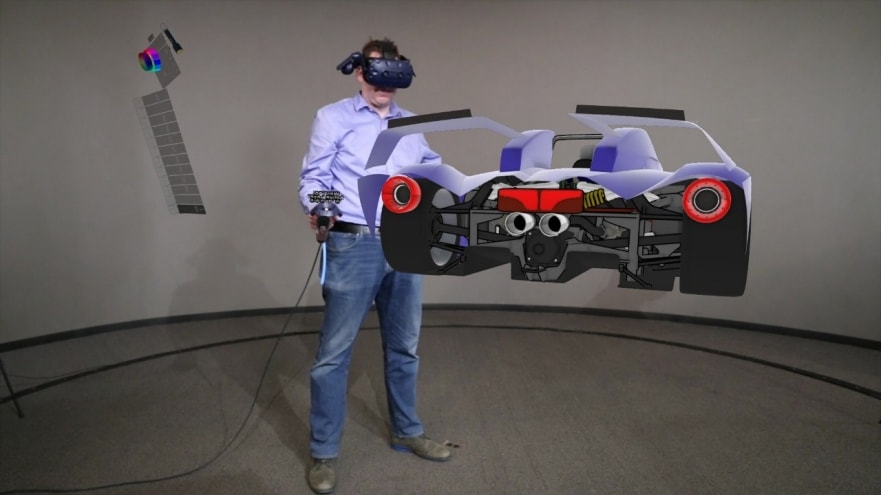
- Ford is the first automaker to work with Gravity Sketch – a 3D VR tool that enables designers to come up with more human-centric designs
- Co-Creation feature in Gravity Sketch gives global designers at Ford the ability to use the same 3D virtual reality design space, improving collaborative efforts and real time decision-making when designing vehicles.
- Co-Creation has the ability to save designers time and reduce the requirement for global travel during the development process of creating new vehicles
DEARBORN, Mich., May 6, 2019 – A designer from Shanghai and another from Dearborn step into a virtual design space together to make changes to a global vehicle design. Both walk around the 3D design, review it and make changes on the fly. Once finished, the two remove their VR headsets and return to their separate workspaces -- thousands of miles apart.
Thanks to Co-Creation, a feature developed by Gravity Sketch in collaboration with Ford, designers across the globe can create, collaborate and evaluate vehicle designs with one another in real time without leaving their physical workspace.
Ford is the first automaker to work with Gravity Sketch – a 3D virtual reality tool that enables designers to create more human-centric vehicle design. Designers trade in their sketchpads for a headset and controllers to become immersed in virtual reality, imitating gestural interactions through motion tracking that replicates sketching with pen and paper. Designers can draw, rotate, expand and compress a 3D sketch. The Co-Creation feature allows multiple designers to engage in content creation, while making these real-time adjustments.
Consumer purchasing trends differ in each global region, meaning an attractive design in one region may not be as appealing in another. Co-Creation gives designers from different regions the opportunity to come together in one space and review a 3D sketch to make important decisions earlier in the design process.
”The Co-Creation feature adds more voices to the conversation in a virtual environment, which results in more efficient design work that may help accelerate a vehicle program’s development,” says Ford Design Manager Michael Smith.
Gravity Sketch allows designers to speed the process from weeks to hours, skipping the 2D stage and working with a 3D model from the beginning. Through Co-Creation, a designer can transfer to another designer’s point of view within virtual reality to see from his or her perspective. This is especially helpful when training other designers in Gravity Sketch.
Across five global Ford design studios, dozens of interior and exterior designers are now experimenting with Gravity Sketch for workflow feasibility and its capability for real-time co-creation and collaboration. Shifting to a model that designs and evaluates in virtual reality could revolutionize the entire process by drastically reducing development time and allowing for more 3D representations in the evaluation stage.
“Our collaboration with Ford designers has enabled us to get immersed in their creative process and discover ways to help fine-tune this application to better suit their needs so they can build the best possible vehicles for their customers,” said Oluwaseyi Sosanya, Gravity Sketch CEO & Co-founder.
About Ford Motor Company
Ford Motor Company is a global company based in Dearborn, Michigan. The company designs, manufactures, markets and services a full line of Ford cars, trucks, SUVs, electrified vehicles and Lincoln luxury vehicles, provides financial services through Ford Motor Credit Company and is pursuing leadership positions in electrification, autonomous vehicles and mobility solutions. Ford employs approximately 196,000 people worldwide. For more information regarding Ford, its products and Ford Motor Credit Company, please visit www.corporate.ford.com
Tuesday, May 7, 2019
VanAir PTO Driven Underdeck Systems Walk Around Video
Understand the unique and powerful components of Vanair's PTO Driven Underdeck Air Compressor/Generator Systems, their benefits and features.
Sunday, May 5, 2019
Taylor Pump & Lift Fuel And Lube Truck - Enoven Truck Body
Sam with Enoven Truck Body goes over a customer Fuel and Lube truck by Taylor Pump and Lift. See more at http://www.enovenind.com
Friday, May 3, 2019
Quick Guide To Industry Acronyms

GVW – Gross Vehicle Weight
This is the total weight of the truck, including all passengers, drivers, cargo, accessories, fuel, and fluid in the engine at any point in time. It is important that this measurement does not go over the GVWR, or it can be a safety hazard.
GVWR – Gross Vehicle Weight Rating
This is the maximum total vehicle weight that is safe for the truck, established by the chassis manufacturer. The weight of the truck, any cargo, and passengers including the driver, as well as any fuel and fluid in the engine is included in the rating. Chassis manufacturers will most often set the GVWR lower than the combined axle ratings (the total amount of weight an individual axle can carry). This is due to the chassis manufacturer’s internal safety standards for durability, stability, and handling, as well as SAE International test protocols.
GCWR – Gross Combined Weight Rating
Everything that moves with the vehicle is included in the GCWR. The weight of the truck, any cargo, passengers including the driver, any fluid or fuel in the truck, as well as the weight of the trailer and the trailer’s cargo is included. Exceeding the GCWR can cause a safety hazard.
Payload
The cargo carrying capacity of a vehicle is the payload. It is calculated by subtracting the vehicles’ weight including passengers and the driver from the GVWR. Exceeding the Payload capacity can cause damage to your suspension, chassis, frame, tires, and many other parts of the truck.
CA – Cab to Axle
The cab-to-axle measurement is the distance from the back of the truck cab to the center of the rear axle. Clear CA or effective CA is the distance from the rear surface of any obstruction behind the cab to the center of the rear axle. If you have a tandem axle truck, then it is measured to the midpoint between the two rear axles. This measurement can help you determine the length of the body that can be mounted on the chassis.
Wheelbase
The wheelbase is the distance between the centers of the front and rear axles. When the truck has more than two axels, it is the distance between the steering axle and the center point of the driving axle group. This can affect body installation, weight distribution, and truck performance.
SRW – Single Rear Wheel
A single rear wheel refers to a chassis that has one wheel on each side of the rear axle. Single Rear wheels make for smoother driving without cargo, as well as easier driving in cities, suburbs, and highways. These trucks are more affordable to purchase outright, and have better fuel economy. A single rear wheel has less towing capability than a dual rear wheel, and less stability when towing in windy conditions.
DRW – Dual Rear Wheel
A dual rear wheel refers to a chassis that has two wheels on each side of the rear axle. This feature is a must if you are towing large payloads, or driving through rough terrain. It adds stability to your truck which increases safety for your divers and cargo. Having a dual rear wheel will allow the driver to safely get off the road in the case of a tire blowing out. Trucks with a dual rear wheel can be difficult to maneuver in cities, where parking and tight streets can be challenging. This feature can also reduce the truck’s mpg, especially in cities, and increase maintenance costs, because there are at least two extra tires to replace or rotate.
CDL – Commercial Driver’s License
The vehicle’s GVWR is one of the factors that will effect whether the diver needs a CDL. If the truck has a GVWR, and GVW of 26,000 lbs. or lower, the driver does not need a CDL.
Class A
A Class A license is required to operate any combination of vehicles with a gross combination weight rating of 26,001 lbs. or more. This includes towing a trailer weighing over 10,000 lbs. which makes the vehicle and trailer rating over 26,001 lbs.
Class B
A Class B license is required to operate a single vehicle with a GVWR or 26,001 lbs. or more, and/or a vehicle with a GVWR of 26,001 lbs. or heavier that is towing another vehicle weighting up to 10,000 lbs.
Class C
A Class C license is required if the vehicle you intend to drive does not meet the criteria for either Class A or B and it is meant to transport either: 16 or more passengers including the driver or hazardous material.
Original Source: NTEA Truck Equipment Glossary
Blog Source: https://www.knapheide.com/news/blog/2018/08/quick-guide-to-industry-acronyms
Wednesday, May 1, 2019
READING Aluminum Classic II - LIGHTWEIGHT DURABILITY YOU CAN TRUST

The first and most rugged aluminum service body, tested on the job for over 35 years.
Our aluminum service bodies are made with heavy-duty powder coated aluminum – a material that resists rust for life. Designed to go anywhere and haul anything, our aluminum service bodies are lightweight yet rugged, so you pack up to 50% more cargo and save up to 10% on fuel.
Leran more at: https://www.readingbody.com/truck-show-aluminum/
Monday, April 29, 2019
Reading Classic II work truck walk around
The Aluminum Classic II offers an unbeatable combination of standard features, useful options, and the know-how of over 25 years of refinement. This service body is designed for efficiency today, and built to last for tomorrow
Subscribe to:
Posts (Atom)